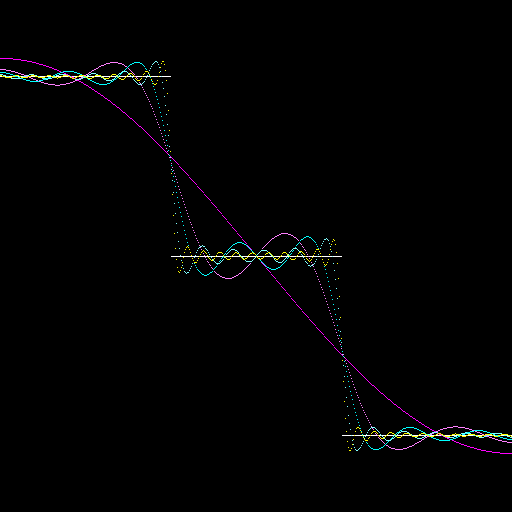
The string is strung for −π/2≦x≦π/2
the initial boundary conditions for t=0 are:
y = 1 for |x| ≦ π/2 and ∂y/∂t = 0.
We extend the symmetry as before by declaring that when t=0 and for −∞<x<∞
f(x,0) = −f(x+π,0) and therefore f(x,0) = f(x+2π,0) and f(x,t) = f(−x,t).
∂f(x,t)/∂t = 0.
As before f(x,t) = f(x,−t).
Now there is a discontinuity when x is an odd multiples of π/2.
The Fourier series for the initial configuration is
y = ∑ ancos nx summed over positive integers.
Any term in sin nx would violate f(x,t) = f(−x,t).
an = ∫ [−π, π] y cos nx dx/π.
The integral is 0 by symmetry (f(x,0) = −f(x+π,0)) when n is even.
If n is odd then ∫ [−π, π] y cos nx dx/π =
| (4/π) ∫ [−π/2, 0] y cos nx dx | Each quarter of [−π,π] yields same integral |
| = (4/π) ∫ [−π/2, 0] cos nx dx | Definition of y |
| = (−1)((n−1)/2)(4/π)/n | we skip a few steps |
f(x,0) = (4/π)∑ (−1)((n−1)/2) cos(nx)/n summed over odd n. This code corroborates these error prone calculations.
This expansion has a slightly different symmetry between t and x.
This solution is tested here.
Below is the solution ploted for 0<x<π at t=π/6 with approximations 1, 2, 4, 6, 16 and 32.
Here is the code.